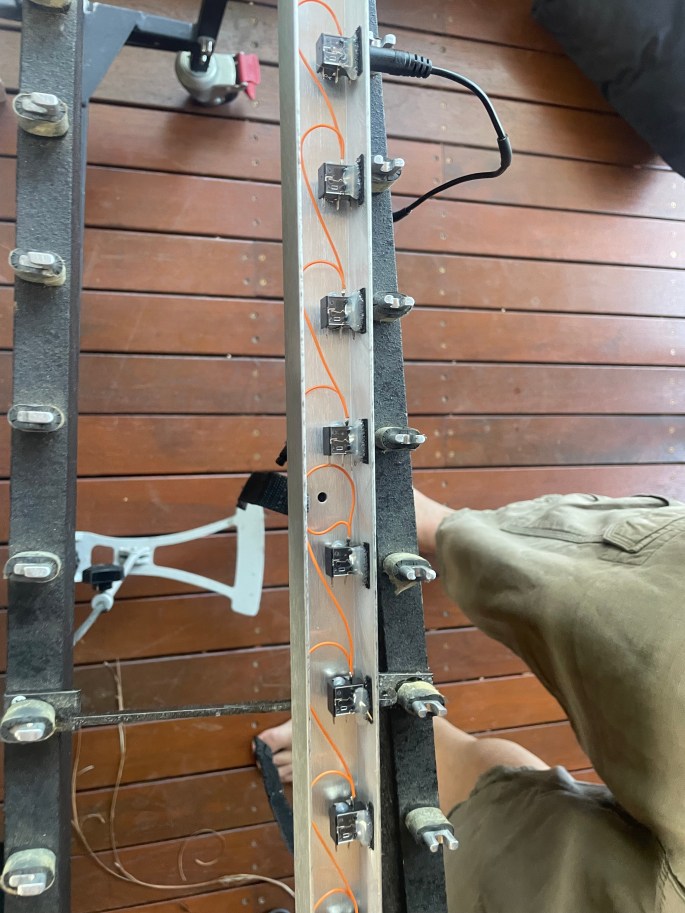
In December 2025, just before Tom was due to leave for Woodford Folk Festival, disaster struck: the vibraphone decided to slip over and completely knocked several sensors off the K&K pickup system. It was one of those heart‑stopping moments musicians know too well—especially with a major festival just around the corner.
Thankfully, Tom managed an emergency fix on the damaged bars sensors so I could still perform at the festival. The solution worked—but only just. The keys he repaired produced much louder sounds than the others, as the replacement sensors were physically larger. The imbalance was obvious and it was clear we’d need to fix things.
After Woodford, we decided the only real solution was to strip everything back and start again from scratch. So once more, the vibraphone was taken apart—every sensor removed—with the intention of rebuilding the system properly.
Around the same time, another issue surfaced. The vibraphone has heavy‑duty wheels that were fitted many years ago by Ross Dovey—excellent, solid wheels that have served me well. One of them had come off, so we planned to fix that on the same day as the sensor and tuning work.
Except the wheel had other plans.
Somewhere between loading, unloading, and rearranging gear, the wheel decided to play hide‑and‑seek. We searched everywhere, but it was nowhere to be found. No wheel. No explanation. Just gone.
At this point, help arrived in the best possible way. Jeff Paton—an exceptional percussionist and percussion teacher, and an old friend of Tom’s from their Bossfight days—advised for the project. Jeff also brought invaluable knowledge about tuning vibraphone bars, opening up another long‑standing issue I had quietly lived with for years.
It turned out the keys were quite sharp, which explained the tuning complaints I’d received in past chamber music projects. With Jeff’s guidance, we decided this was the right moment to address everything at once: new sensors, improved balance, and re‑tuning the bars themselves.
We finally set a date to do it all properly—with Tom, myself (Noz) and also Tom’s nephew Ethan, whose help and patience made a real difference throughout the day.
We worked all day—assembling, measuring, listening, adjusting, rethinking. And yet, despite everyone’s care and expertise, we didn’t succeed. The result still wasn’t right. The instrument told us, very clearly, that this approach wasn’t the solution. It might have been the piezo sensors. . . hard to tell once daylight had gone and Tom no longer had energy to troubleshoot circuitry.
So we stopped.
We’ll have to do this again—in a different way.
It’s frustrating, humbling, and exhausting. Making things right—truly right—can be incredibly hard. But this instrument matters, and so does the music it’s meant to carry. Sometimes progress looks like persistence rather than success.
To be continued.
Written by Noz
 Shugorei